


I found a picture of a very similar aberration, at the bottom of this page (left): http://en.butterflycorner.net/Papilio-machao…ueue.378.0.html
Regards, Klaas
I found a picture of a very similar aberration, at the bottom of this page (left): http://en.butterflycorner.net/Papilio-machao…ueue.378.0.html
Regards, Klaas
I had some success getting a second generation in October/November by keeping the caterpillars at room temperature,
but the resulting adults were not fertile.
Regards, Klaas
Here are some pictures of a female with alpicae-characteristics I think (I hope it's not wishful thinking!), Valais, 1800m height.
Not all specimens that I saw were this pale, but almost all specimens had orange instead of eyes.
[Blockierte Grafik: http://ic2.pbase.com/o6/36/682736/1/126756009.vaej6Quj.alpicae.jpg]
[Blockierte Grafik: http://ic2.pbase.com/o6/36/682736/1/126756017.bffZ4SWj.alpicae2.jpg]
Hi everyone,
I would be very interested in any information regarding the Papilio machaon subspecies/form 'alpica'.
If it is more than only a cold-form, does anyone know if it also occurs in Valais near Martigny?
One week ago I let a few wild females (from 2000m-2100m height) lay eggs in captivity and I released the butterflies the next day.
These females were very pale yellow with orange eyes and they were more hairy than 'normal'. I will rear part of the caterpillars
at alpine conditions and the the others at lowland conditions. If possible I will also use different foodplants, until now they have
only accepted Angelica. If the characteristics from the females have a genetic basis, they should be visible in the offspring reared
at both conditions am I right? I will post some pictures of some P. machaon specimens that I photographed soon.
Regards, Klaas
Dear Benjamin,
I tried to attract males from 00:00 to 01:45 but without any success :wacko:
Regards, Klaas
Dear Rudi,
Thank you very much for your help!
Regards, Klaas
Hi everyone,
I have a few L3/L4 caterpillars from H. fuciformis that I'm rearing on Lonicera. Next week I will go to Wallis
to a place of which I know that it contains only Symphoricarpos and no Lonicera. I'm not sure if I should take the larvae
with me or if I should leave them at home on netted Lonicera plants. Does anyone have experience with changing
foodplants of h. fuciformis larvae?
Best regards, Klaas
Hi everyone,
This evening I would like to attract G. quercifolia males with a reared female. Does anyone know at what
time in the evening the males start to fly?
Regards, Klaas

Hallo,
ist diese Libelle ein weiblicher Plattbauch oder ein Vierfleck?
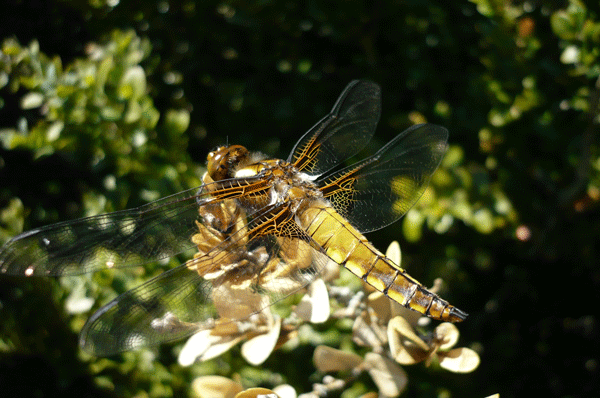
I don't agree, it's a fresh male. Have a good look at the claspers!
Regards, Klaas (http://www.pbase.com/klaasvanhaeringen/libellen)
I had the same problem with E. potatoria. I think it's best to keep the caterpillars outside because they need dew and rain drops.
My caterpillars started to grow again when I put them on the grass in my garden, covered by a mosquito net.
Regards, Klaas
Thanks for your help! Unfortunately, each day I'm still losing more caterpillars. After their moult, some L4 caterpillars
walk around continuously until they die. Other caterpillars don't continue to feed after their moult and they simply
dry out. Strangly, part of the caterpillars show no sign of disease (yet?). It's very frustrating: I lost more than half of my
caterpillars (25) in only 3 days! Has no-one else had this problem with G. isabellae?
Regards, Klaas
Hi everyone,
Until yesterday my caterpillars from isabellae were growing very well and from the egg to L3 almost no caterpillars died,
only 2 from 45. Suddenly, during the moult from L3-L4 (and one caterpillar from L4-L5) many died. They either stiffened
and fell off the twig, or they completely relaxed.
I keep them in large jars at a relatively high humidity, but I don't spray the food or caterpillars with water. I clean the jars each
day and I refresh the food daily. I'm afraid that I will lose all of my caterpillars if I don't do something quickly. I don't think a bacterium or
a virus is the cause, because the non-moulting caterpillars show no sign of disease and not all caterpillars died during their moult.
All hints are more than welcome!
Best regards, Klaas
It's Lycaena tityrus, a male.
Regards, Klaas
Well, I can tell you one thing about all Lasiocampidae: the adults don't eat!
Regards, Klaas
It might have been a fungus, so make sure the caterpillars have enough ventilation!
I'm also very interested, also if there is any hard evidence about isabellae occuring there before people let
moths loose in the area?
Something very different: I would not advice anyone to hand-pair isabellae. I now found out for sure that of 3 paired females,
2 laid only unfertile eggs. The 3rd female did lay some fertile eggs, but only about 13%. Hand-pairing the moths during the evening
at low temperatures may cause them to mate longer with a possibly higher hatching rate of the eggs.
Best regards, Klaas
It won't eat anymore, the darker back shows that it's ready to pupate.
Regards, Klaas
It should be very easy! I once had a fresh female that I photographed when the wings were ready. I then put the female on a Tilia tree in my garden
to let it fly away. The next morning I found the female back by coïncidence (it was very windy and it had fallen out of another tree).
I put it in a jar and the next night it laid many eggs that were all fertile!
Dear Amerett,
Why don't you use a mosquito net? They are cheap and if you use one for 2 persons, the moths
have plenty of space to fly around in.
Regards, Klaas
Hi everyone,
Here is a short update of my breeding of isabellae this year. The eggs of 2 females that mated for over an hour,
seem to be unfertile. I have no idea how this is possible, the moths were not disturbed during the mating and after
they separated, the females almost immediately started to lay eggs.
Fortunately the second hand-pairing was successful, the eggs that were laid on the first night have started to hatch after 15 days.
The female that laid these eggs only mated for 15 minutes. I then hand-paired the female with the same male again and they
continued to mate for half an hour. Next week I will know the percentage of how many eggs hatched.
The only advice that I could give to you Amerett, is to keep the males cold (in the fridge) and try to hand-pair them. Or else
I would just keep the males in a large flying cage or under a mosquito net outside. When it's dark, I would put the females in the
same cage, the males should start to fly I think. Good luck!
Regards, Klaas
